
Dr Rush versus Dr Stevens
Medicine has been political for a long time.

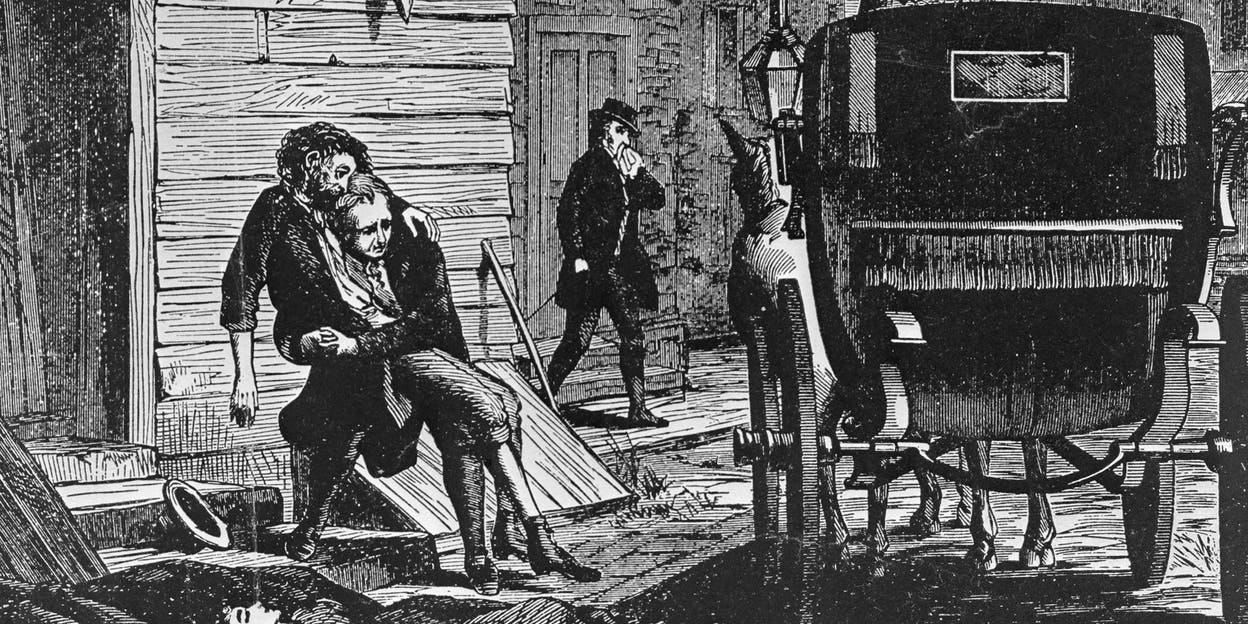
It was in August of 1793 when residents who lived on the wharves of the Philadelphia docks started to turn a repulsive jaundiced colour, their eyes became red and they vomited a black bile from their bleeding stomachs. This had been preceded by the initial stages of chills and severe muscular pain from which the disease progressed to the perilous, often fatal, acute stages of Yellow Fever.
The disease had swept through the West Indies that year and a slave revolt in Santo Domingo had brought many refugees carrying it into mainland United States through the port of Philadelphia. Aided by a wet spring and a hot, dry summer and abetted by appalling sanitary conditions with gutters clogged by discarded detritus and filthy individual habits such as residents drinking from the contaminated water of outhouses.
By the end of the month, twenty people a day were dying. Coffin makers received a boom in business and vocally hawked their wares on the street. At the time, inhabitants did not know that mosquitoes spread the infection but they did know that it could be contracted from contact with infected persons so a form of improvised social distancing was introduced: no hand shaking and sticking to the middle of the street instead of the pavement when ambulating.
Reminiscent of Enlightenment Edinburgh, and recent Covid Times, and equally as ineffective as a preventative measure, people attempted to create a sanitary bubble around themselves by holding vinegar-dipped handkerchiefs over their nose or chewed garlic to placate their nostrils, and sense of well-being, with the vapours released from their masticating.
None of it worked, nothing abated the pestilence that enveloped the city. Yet among this scene of panic, fear, disease and death, the sprightly, ‘pretty’ figure of the city’s leading physician Dr. Benjamin Rush could be witnessed, striding confidently from the houses of the rich to those of the poor, discriminating against none, as he single-handedly defied the fever to take him and those charges under his care.
His approach was not one out of step with the prevailing wisdom of the day, although to us now it sounds wilfully barbaric, almost murderous, and so replete with contradiction that the poor unwitting doctor might be fitted with the term ‘mass murderer’ rather than the hero of Philadelphia. To begin, he bled and purged the victim; this was followed by an emptying of the bowels four or five times utilising a dispensary of potions and enemas, and then finally, for good measure, he drained ten to twelve ounces of blood to lower the pulse. In addition, he applied an emetic for good measure. To ensure success, this regimen was undertaken two or three times every day!
It is a wonder anyone recovered. Under the circumspect view of our modern eyes, the incapacitation of the body’s natural defences and debilitation of its capacity to recover and regenerate seems like insanity from a medical man, a man of purported science. How could a patient convalesce while their immune system was thinned and weakened while nourishment was withheld? Fortunately, there were dissenters.
When Alexander Hamilton, the uniquely brilliant Treasury Secretary of Washington’s first government, succumbed to the plague, he was tended to not by Dr Rush, the most renowned physician, but by his old friend from his impoverished childhood who had now become a successful physician Edward Stevens. His formative companion had practised in the West Indies and had a great deal of experience with tropical diseases. He did not subscribe to the common theories of purgation, concluding that these measures weakened the patient rather than aiding the restitution of health.
Instead of an approach closer to Medieval application of leeches, Stevens applied remedies that were ‘cordial, stimulating, and tonic’. To us in the present a few may seem a little extreme, cold baths and alcoholic drinks, albeit the use of natural flowers and plants may be welcomed, nonetheless, Stevens’ methods maintained the integrity of the body and augmented the exposure to minerals and compounds which the patient had been lacking.
The proof is in the pudding. In contrast to the weeks spent by the infected hovering near death, barely surviving the cure never mind the fever, Alexander Hamilton and his wife recovered in five days. Buoyed by his speedy revival, Hamilton set himself to proselytise Steven’s protocols with vigour. To his credit, swallowing the implicit rebuke and proscribing the awful thought that he was doing more harm than good, Dr Rush gave the new system a try for a few days; however, it failed to produce results as successful as his colleague. Infuriating Rush enough to resort to the public to defend his method and deprecate his rival.
Unfortunately, matters soon descended into the swamp of partisan politics since Rush was a supporter of Thomas Jefferson, a man who envied, feared and loathed Hamilton, and it was declared that Hamilton’s ‘Federalist’ medicine was as revolting and as fatal to the needs of the patient as his funding system was to the newly founded United States and its government. Rush ‘Republican’ methods were the only remedy to the situation. Two competing medical points of view, legitimate in that, as far as can be discerned, they were both sincerely held, were befouled by accusations of misanthropy and conspiracy on both sides, and a public, genuine application of the scientific method demonstrating a successful approach, beneficial to all, was made impossible. Sadly, the public lined up on either side guided by their party affiliations and not their reason.
Interesting to note in passing that when Hamilton was to be reunited with his children who had been moved to his father-in-law’s Albany mansion, his arrival was viewed with agitation by the local mayor. He asked Philip Schuyler, the father of Hamilton’s wife, that a guard be posted outside the family home to prevent Hamilton from mingling with the citizenry. Schuyler, under pressure, compromised and assured the official that his family would not leave the estate, and asked sarcastically if the guard could drop off food in the garden so the possibly contaminated could eat. It would take nearly 230 years for a world to exist where people voluntarily practised such absurdities.
Do we ever learn? Wasn’t the controversy over Ivermectin an issue that could have been quickly resolved by honest, public investigation, indeed, putting to one side the actions of bad actors, Epstein affiliates, and a clear plan to do mischief to billions, could not the entirety of Covid been stopped before the nonsense started if doctors and people of science simply stood up, openly questioned and refused to accept false, disingenuous or unprovable statements from the hierarchs?
The issue of vaccines is perhaps more apposite. In two hundred years time, I wonder what the reaction will be of future men and women when told that people injected themselves with the virus they wanted to avoid, sometimes modifying their DNA to continually produce them for years into the future, accompanied by adjuvants that included some of the planet’s most toxic chemicals. It sounds absurd, irrational, barbaric, murderous in the first instance, but then when they take into account this is correlated by explosions in the cases of autism and cancers, then what will they conclude about us?
And isn’t refusing to entertain a debate on theses points anything other than base, unthinking partisan politics, which is always a cover for hidden interests?

We have now moved to a paid subscription model for the Common Knowledge Blog. Most of the posts will remain free, but we are hoping that people who share the values of a free, pro-human future will support us. All the money we receive goes to our campaign for that free, human future. You can contribute by a paid subscription to this substack of £10 a month or a £100 annual membership.
KEEP IN TOUCH.
Email: commonknowledgeedinburgh@tutanota.com
Follow us on X @wercomknowledge
Watch our previous meetings on YouTube - @CommonknowledgeEdinburgh
On Rumble - Common Knowledge Edinburgh
On Odysee - Common Knowledge Edinburgh
See our events and content on Linktree.
Fascinating story, excellent writing. And much to think upon.
Incidentally, I hold that cold baths (when shockingly cold) are indeed a powerful immune therapy.