
The Welfare State
Almost twenty years after the financial crisis, the state is funding everything.

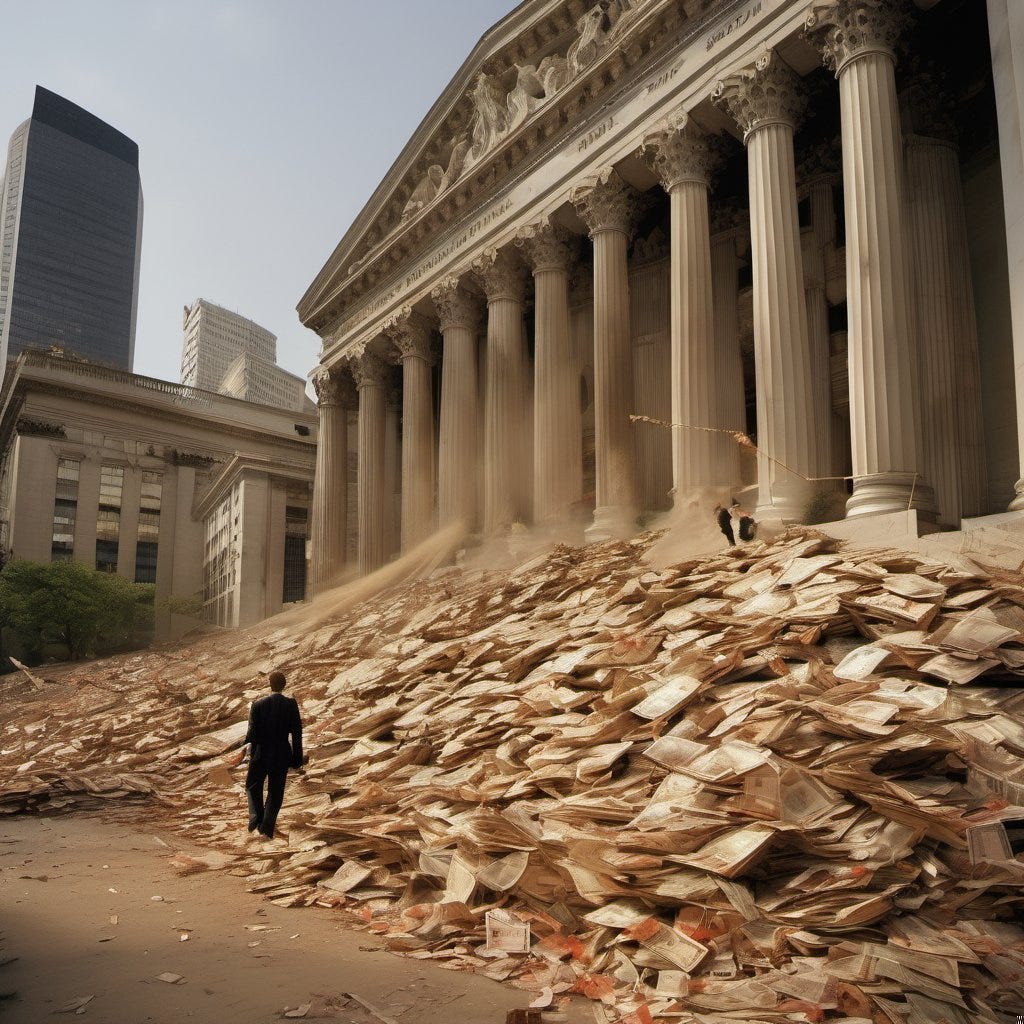
The global economy is bankrupt. From the 2008 financial crisis until today, the world has been living in an asymmetric system: ‘asymmetric’ in the sense that what was formerly a complete framework of financial accounting has partially dismantled a few supporting struts, removed to allow what remains to form some sort of stable existence. A fact that is counter-intuitive to anyone who has a view which conceptualises systems as being cohesive working wholes with mutual interdependency between parts, which, if not the actual case, then they are simply broken.
At a very early stage during the collapse of the banking system eighteen years ago, the requirement to mark assets to market was removed. This means that if a house had been purchased with a loan of a £1 000 000 and was now worth £800 000, then there was a loss of £200 000. Due to accounting rules, the bank which had lent the money originally. that previously have a one million pound asset, would now have an asset on their books showing a £200 000 reduction. Losing money unsettles banks, and markets, encouraging fear of further loss, whether rational or irrational, and therefore rules have been put in place to ensure that these losses are covered. Banks make what is called a ‘margin call’ to their debtors.
The debtor, in this situation, either has to pay back the principal sum or pay the deficit, ‘the margin’, between the loan and the asset to assure the jittery lender they will get the return of money previously leant in order to provide confidence in the borrower’s solvency. These protocols only work if debts are recorded realistically, and they are in place for very good reasons.
Given the interlinking dependency of financial transactions, a loss of faith in credit’s allocation, are like explosions of dynamite connected on a series circuit: the charge blows up one bundle of sticks, then another, and then another, all along the wire, as demands are made for payments that necessitate the liquidating of further assets which drive down these other prices and since these other assets were likely purchased with loans, precipitate require further demands on cash.
A fire sale flares across markets where asset prices fall quickly, the original nominal cash values are destroyed, gone for years, possibly forever, loanees thus remain heavily indebted; despite selling everything they are unable to clear their losses, and creditors are wiped out with loans which are unable to be repaid. Under the modern credit system, it is not only hypothetically possible that the system goes to zero, it is inevitable that it will do so and then go beyond that figure to a negative number, because the debt, augmented by interest payments, is far greater than the cash in the system. Operating under reckless, speculative behaviour, the negative numbers of the accounting book blast past zero with no end point in sight.
It is the refutation of Say’s Law. A theory that claims that all deficits and all surpluses cancel each other out. Unfortunately, Jean-Baptiste Say ignored something that every credit card user is all too familiar with – interest. Debt accrues due to interest on that debt. Unhappily, money does not likewise increase simply by its existing and the cases where it appears to do so is due to the transfer of payments from those who have borrowed it into existence, by whatever circuitous means.
The economy is a like a frenetic swirling sieve where the draining out (debt) has to be equalled or exceeded by the pouring in of liquid (credit) otherwise we face a collapse in demand – people having the cash to buy actual goods and services. In many respects, monetary systems live on a precipice, as Covid demonstrated, a sudden loss of confidence, which if continued without recovery over a relatively short time period can create a debt spiral that it is impossible to arrest endogenously i.e nothing within the system can stop the tailspin.
This is where central banks aided by government can step in, and did so in 2008, supplying ‘exogenous’ growth. Massive money printing begun then, and continuous to the present day, alongside the already mentioned relaxation of accounting rules, halted the collapse and has subsequently kept the economy functional on the surface at least. However, the real economy is bust. Injections of money, increased government spending and fraud, all combined, have allowed it to survive this far; akin to a patient who requires regular blood transfusions, steroids and a machine to continue breathing, and although the patient is kept technically in a state of existence, if required to be reliant on their own efforts, they will die. Growth supplied from within the system – borrowing money and spending to either consume or the expectation of returns – is too little to maintain the current size of the economy.
In normal circumstances, confidence would restore the economy. However, it illustrates the extent to which rampant, unregulated and unscrupulous borrowing piled-up unpayable debts that despite unprecedented institutional intervention, confidence has not returned sufficiently to engender growth which is not led and underwritten by government spending.
Yet the situation is worse than even this poor sketch of mercantile matters suggests: the amount of money used to bail out banks and other lenders should have caused massive inflationary pressure, especially so as the same actions have been performed near constantly over the intermittent years. There has been a massive, skewed rise in some assets, in particular the stock market, which now has share prices far in excess of even hopefully optimistic profits based on near impossible real-world scenarios. However, the volume of liquidity sprayed over these economic fires should have meant an unbridled torrent of inflation that raised all prices. This did not happen, despite permission to banks to sterilise bad debts and move them off their books. It is a testament to the fraud and greed of the late nineties and early two thousands that the debts that remain today still act as a too-heavy ballast dragging down the economic ship below the waterline.
Regardless of the richest’s gains in cash and asset price, the rest of the economy still labours in near-recession where inflation combines with stagnant wage growth and a higher tax burden to eat away at people’s disposable money. As mentioned, the government funds more and more of the economy, bailing out those on welfare, providing workers with supplemental income and professionals with an array of non-jobs in the arts, think tanks, charities and the civil service.
What this resembles ultimately is a neo-feudal state reminiscent of the dreams of fascism. All economic activity is now dependent on the state, whether handouts are to corporations or the individual, since the economy cannot maintain itself under its own steam. As this trend has been allowed to continue, markets have become captured by those monopolies favoured by the state and, slowly and unnoticed, all aspects of the economy are brought under control at the macro level.
Digital currencies potentially create an opportunity for control at the micro level too, thus presenting the prospect of a vast administrative state dominating all areas of economic activity. Money will be allocated from a central authority aligned with protocols implementing policies agreed far, far away from the people they effect.
Whether people agree with this or not, this is a carefully thought-out response to an economy that almost twenty years after it blew-up is still dysfunctional. There are four salient points I would like to mention as food for thought, however: the first – it is the oldest trick in the book to encourage speculative excesses by loosening lending practices, creating a boom, then in the subsequent crash buy up real assets, and thereby gaining the commanding heights of the economy; the second – if we consider what did not happen, the bailing out of debtors instead of creditors (who were also debtors), then there is a class element to the re-shaping of the economy; and, thirdly, by preventing collapse, the state has created a role enriching further the already rich, empowering its officers to a heady state of arrogance and making everyone else dependent.
The fourth is a dispiriting one: there is no loan without a loanee, and the wealthy know best of all, there is no crazed speculative asset bubbles without a mass of small-time speculators hoping to get rich quick and fund a lifestyle far beyond their current means. As Thomas Jefferson noted, once the tailor enriches himself in a day, even if it is lost the next, then he forever turns dissatisfied from the honest wage provided by his needle never to return. People’s greed about inflated house prices, funding living through loans and credit cards, and borrowing to place ‘one way bets’ on land and properties, led the world into the hands of neo-feudalists who could rightly point at the madness of crowds in throwing away financial security in a game they only dimly understand.
All of these are crucial elements in building a fascist society, that people do remember was anti-democratic, but forget that it was also anti-capitalist, anti-free markets and opposed to any individual initiative outside of the state. If we wish to escape the destination of this trend, then a change of values is required.

We have now moved to a paid subscription model for the Common Knowledge Blog. Most of the posts will remain free, but we are hoping that people who share the values of a free, pro-human future will support us. All the money we receive goes to our campaign for that free, human future. You can contribute by a paid subscription to this substack of £10 a month or a £100 annual membership.
KEEP IN TOUCH.
Email: commonknowledgeedinburgh@tutanota.com
Follow us on X @wercomknowledge
Watch our previous meetings on YouTube - @CommonknowledgeEdinburgh
On Rumble - Common Knowledge Edinburgh
On Odysee - Common Knowledge Edinburgh
See our events and content on Linktree.